
When You Sample Soil Matters: Lessons for Corrales Growers
A soil test offers a snapshot of field conditions—but that snapshot can change with the season. Research from New Mexico State University shows that sampling at different times of year can produce noticeably different results, even when the land is managed in much the same way.
Researchers collected soil samples during fall, winter, spring, and summer from fields planted in alfalfa, cotton, and pecans. They measured physical, biological, and chemical indicators of soil quality, including available water, compaction, organic matter, active carbon, nutrients, pH, salinity, and soil structure.
The study’s most useful finding for small farmers is simple: the season in which a sample was collected often affected the results more than the type of crop being grown.
Several measurements were especially sensitive to seasonal change:
Available water
Bulk density, an indicator related to soil compaction
Soil organic matter
Active carbon, which reflects the portion of soil carbon readily used by microorganisms
Extractable potassium
Soil organic matter readings were highest in winter, while active carbon was highest in fall. Available water also changed substantially over the year. Nitrate behaved differently depending on the crop, probably because cotton and pecan fields received nitrogen fertilizer while alfalfa did not.
Other measurements—including salinity, manganese, and iron—were comparatively stable. The researchers suggested that the region’s limited rainfall and the buildup of nutrients near the soil surface may help explain why some chemical indicators changed less from season to season.
What this means for a Corrales farm
For growers tracking soil health, consistency is essential. If one sample is collected in April and the next in October, an apparent improvement or decline may partly reflect temperature, rainfall, irrigation, crop growth, or recent fertilizer applications—not a lasting change in the soil.
To make year-to-year results more meaningful:
Sample during the same season each year.
Use the same sampling depth and approximately the same locations.
Record recent irrigation, fertilizer, compost, and manure applications.
Avoid comparing samples taken under very different moisture conditions.
Tell the testing laboratory what crops are being grown and how the field is managed.
Look for trends across several years instead of reacting to a single result.
The researchers sampled the top six inches of soil, so the findings are most relevant to surface-soil monitoring. Corrales growers with orchards or deep-rooted crops may also need deeper samples, particularly when evaluating salinity, nitrate movement, or conditions in the root zone.
The takeaway is not that soil testing is unreliable. It is that soil tests become far more useful when they are collected consistently. Choosing a regular annual sampling window gives farmers a clearer picture of whether changes in compost use, cover crops, irrigation, fertilization, or tillage are actually improving the soil.
Based on the NMSU research poster by Dr. Mohammed Omer and colleagues:
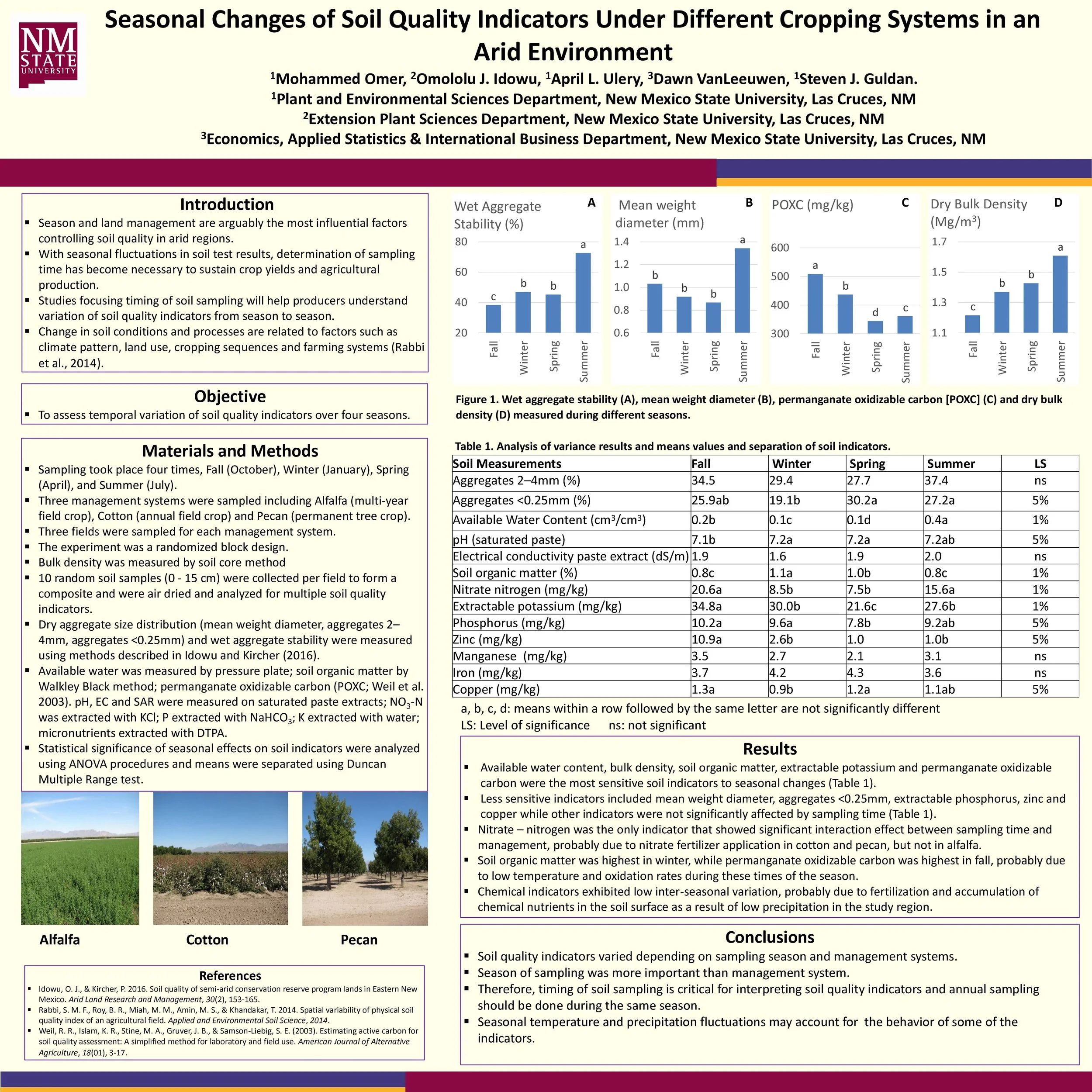
Scientific Poster lead author Dr. Mohammed Omer, NMSU
Find out more here: https://scholar.google.com/citations?user=8dBMkn4AAAAJ&hl=en
NMSU extension offices now recommend using out-of-state regional laboratories like Colorado State University, Ward Laboratories, or IAS Laboratories for soil sample analysis.
Alternative Regional Labs
Colorado State University: Commonly recommended by NMSU extension agents because its testing methods align closely with Western soil needs. Contact via the CSU Soil Testing Lab. Soil Testing Website
Ward Laboratories: Offers agricultural and garden soil testing. Call them at 1-800-887-7645. Website
Recommended Tests to Request
Saturated paste extract: Measures pH, electrical conductivity (EC), and sodium adsorption ratio (SAR).
Nutrients and matter: Walkley-Black organic matter, inorganic nitrogen, phosphorus, potassium, and critical micronutrients like iron and zinc.
For More Information Visit: Click on the colored textto open links
Review NMSU Guide A-114 for step-by-step instructions on collecting and packaging your soil sample.
A-148: Understanding Soil Health for Production Agriculture in New Mexico
NRCS maintains an interactive Web Soil Survey
CR-676: Interpreting Soil Tests: Unlock the Secrets of Your Soil
Contact the Sandoval County Extension Office for localized guidance or help interpreting your final lab report.
